

The Magic Beneath the Magic
Exploring the three fundamental qualities that transform a good story into true fantasy.

Hi, I’m Stace, and this is Magic & Ink, where I write about fantasy writing, creative living , and magic. I’m a professional writer and editor who loves to make things. Learn more about working with me at dumoski.com.
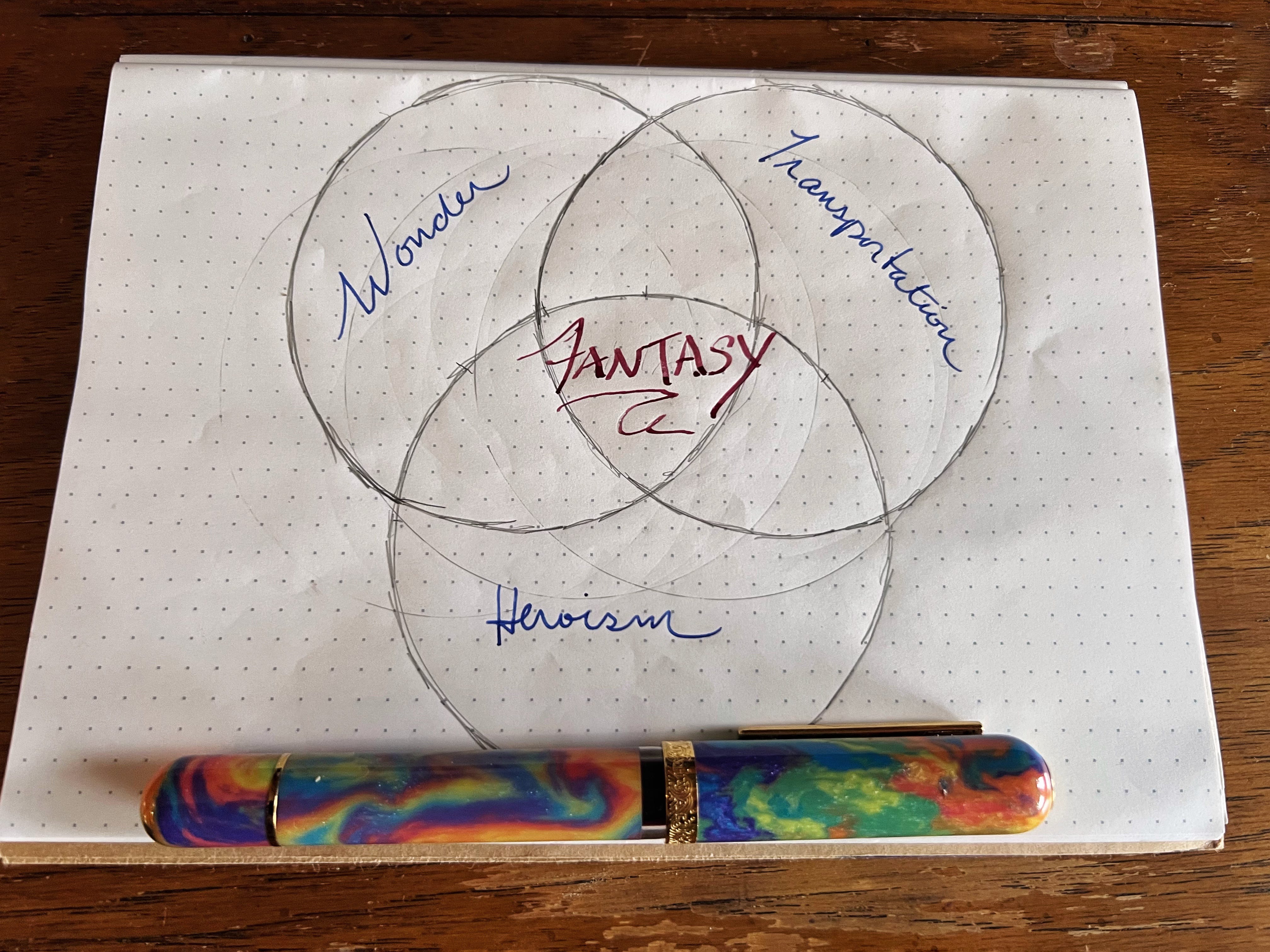
What are the essential qualities of a fantasy story? It’s easy to get distracted by the aesthetic imagery of the genre — swords and dragons, wands and wizards, all the rest — but as much as I love those elements, it’s really all just window dressing that can be replaced at will to create different effects or moods. They’re not what make fantasy Fantasy.
Beneath all the pageantry (whatever the aesthetic) there are three qualities that beat at the heart of every (most) great fantasy novels. I say “most” because usually these three qualities function like the legs of a stool; take one away and the whole thing topples. But in some novels, one leg is so strongly supportive that you hardly notice if one of the others is missing. But those cases are rare and are the exception to the rule. (I say “rule” but this is really just me chasing ideas around my own head.)
I’ll spare you any more throat clearing and tell you what those qualities are. Hopefully you’ll stick around to see my reasoning.
They are:
Wonder
Transportation
Heroism
Wonder: The Sense of Possibility
In the original draft of this article, I had started this list with “Magic.” It seems obvious, of course — if a story doesn’t have magic is it actually a fantasy?
However, requiring magic might disqualify some my own favorite novels that fall into the fantasy genre, such as Ellen Kushner’s Riverside books, which are wizard and dragon free (though there are plenty of swords!), and many of Guy Gavriel Kay’s novels, where magic is barely hinted at as a possibility. So it strikes me that “wonder” is a better, more inclusive term for this characteristic.
What, then, is wonder? My favorite definition right now describes it as that elevated feeling that comes when you touch the frontiers of every day experience [reference]. It is a sense of otherworldliness and not-quite-realness that is brimming with potential, possibilities, and awe.
Of course most fantasies can and do rely on magic to provide that sense of wonder. It’s what makes fantasy fun, that opportunity to play with forces that we don’t have access to in the ordinary world. What if you could light a candle by chanting a spell? What if you could drink a potion and change your shape? What if you could pluck a flower and summon a fairy or run into a deity at your local tavern? All fiction begins with the question of “what if” but none does it with more daring or panache than fantasy.
But even in fantasies that do not make use of magic explicitly, wonder still persists. It lies in the gap between what is real and what might be real if only our world was just a little different.
It that liminal space, that gap, we are challenged to look beyond the limits reality places on our consciousness and consider the world in a new and wondrous way. Experiencing wonder in a fantasy story can change us, just as much as witnessing a beautiful sunset, listening to a moving piece of music, or having a profound spiritual experience. No, not every fantasy story is deeply profound, but it still opens up that door for wonder to slip in and grow.
Transportation: The Journey Into Wonder
But that brings me to the second quality of fantasy: Transportation.
By transportation, I don’t mean flying carpets, though we can certainly include those and other fanciful means of getting from place to place as wonders if we want.
What I mean, though, is the ability of the story to transport the reader into that liminal gap where wonder occurs. It might be considered the mirror image of escape, a term that is often used to deride fantastic literature and its readers. But the term “escape” suggests that the reader is trying to get away from the real world; they want to forget whatever travails they are experiencing for the time they are engaged with the story.
Transportation, on the other hand, is running towards something, not away. A reader who seeks to be transported is seeking something that is simply unavailable in their ordinary lives. They have to step into an imaginary world to find it.
It is this quality that really distinguishes the best fantasies from those that feel like pale shadows, simulations or reflected images, not truly immersive worlds. If a writer is not skilled enough — in worldbuilding, description, etc. — to make the reader believe that the story could be true if only… then wonder remains elusive.
You’ll notice that there is a lot of overlap between Wonder and Transportation, which feels right to me as I work my way through the first iteration of this construct. Wonder is the feeling the author wants to convey and transportation is the means (the vessel or vehicle, if you will) that connects the reader with that feeling.
Heroism: The Point of It All
Finally, we come to third quality of fantasy — heroism.
If wonder is the feeling and transportation is the means, then heroism is the point — the why for telling this fantastic story in the first place.
Heroism is a fraught concept in our post-modern literary landscape, which seems to prefer shades of gray to black and white. Nevertheless, heroism is still beats at the heart of fantasy literature.
Of course heroism come in may flavors, and heroic acts can have a lot of different forms. But the basic character arc in most fantasies is that the protagonist must overcome their flaws not to achieve a personal goal (or not only a personal goal) but to stand up to the evil forces in their world, whatever shape those evil forces may take. There aren’t many other kinds of fiction where heroes get to act so explicitly heroic.
Neither is heroism so explicit in our daily lives. Let me qualify that statement: there is actually quite a lot of heroism in our day to day lives. Usually, though, it just looks like hard work. Firefighters, health care workers, teachers — countless people do heroic things every day, but they are the kind of heroic acts that are taken for granted. The heroism is real, but it’s embedded in the texture of normal life. There’s no liminal space around it, no gap between what is and what could be.
But when heroism is connected to wonder, it becomes aspirational in a way that transcends the ordinary. The wonder creates a kind of elevation or intensification that makes the heroic act feel not just brave or difficult, but mythic and transformative.
When heroism occurs in the presence of wonder, in that gap where the impossible feels possible, it takes on different dimensions. It becomes visible, the stakes and the heroism explicit. When a character faces down a dragon or resists a corrupt magical system, we can see the darkness they’re fighting. There’s no ambiguity about what’s at stake or why their actions matter.
In a fantasy story, characters don’t just do heroic things, they become capable of them through engaging with the wonder itself. They learn magic, they grow into prophecy, they tap into ancient power. The wonder is what makes their heroism possible.
Heroism connected to wonder can represent things that ordinary heroism can’t quite capture — the fight against abstract darkness, the victory of hope over despair, the power of standing up when everything seems impossible. The mythic weight resonates symbolically, drawing the reader through an archetypal journey that has the power to elevate and transform the reader who shares the experience.
The appearance of these three qualities — wonder, transportation, and heroism — is going to be different in every work of fantasy, but they will be present regardless.
If you’re writing a fantasy novel, ask yourself these questions:
Does this story evoke wonder?
Will it transport readers to that liminal space where the impossible becomes possible?
Does it show heroism that matters, that can transform not just the characters but your readers too?
If the answers are yes, then you’re on the right track to creating something that transcends genre conventions and aesthetic choices. You’re creating a true fantasy — and that’s a kind of magic all its own.

What do YOU think are the essential qualities of a fantasy novel? Please share your thoughts in the comments! And if you want to support my work, please buy me a chai!

Join the Analog Writers Club, a community for people who like to write by hand. Annual memberships are 50% off through the end of January 2026, and all paying subscribers are eligible for monthly giveaways, including this month’s prize of a $200 fountain pen. Find out more about the Analog Writers Club.