

10 Big Ideas from Big Magic
Exploring Elizabeth Gilbert's guidelines for creative living.

“The essential ingredients for creativity remain exactly the same for everybody: courage, enchantment, permission, persistence, trust — and those elements are universally accessible.”
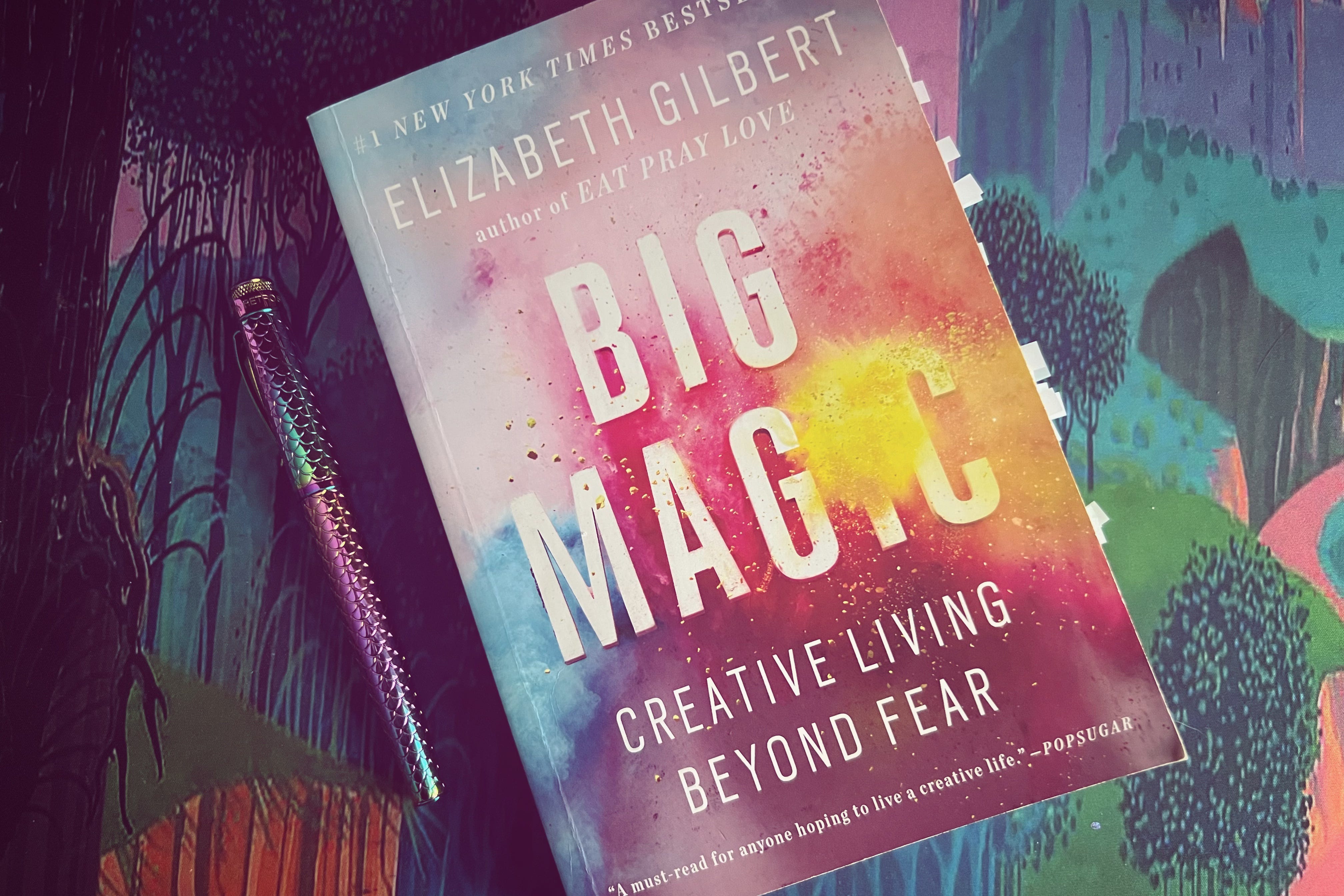
This is the main thesis of Elizabeth Gilbert’s 2015 creative manifesto, Big Magic: Creative Living Beyond Fear.1
Gilbert is most famous for her book Eat, Pray, Love and the movie based on it. More recently, she has faced some controversy about her latest book, the memoir All the Way to the River. But no matter how you feel about Gilbert and her other work, Big Magic has a lot to offer people who want to live more creatively. Whether you’re a writer, a visual artist, a musician, or just someone who wants a life that steps beyond the ordinary, you’ll find something to inspire you in this book.
Hi, I’m Stace, and this is Magic & Ink, where I write about fantasy writing, creative living , and magic. I’m a professional writer, editor and book-coach-in-training who loves to make things. Learn more about working with me at dumoski.com.
Join me for a free Write Together Thursday, Feb. 19 at 6 p.m. PST.
1. Strange Jewels
“The universe buries strange jewels deep within us all, and then stands back to see if we can find them.”
Gilbert begins with a somewhat radical idea — at least an idea that is radical in our modern world shaped by conformity and consumerism.
Every person has buried treasures within them, she says, and the process of uncovering them is through creative living. The courage to go on the hunt for that treasure is what separates a mundane existence from an enchanted one.
According to Gilbert, creative living doesn’t necessarily equate to making art or writing; pursuing other skills, even sports, can be paths to creative living. She talks about a friend who, in her 40s, began learning how to figure skate, not because she had ambitions of performance or competition, but just because she was curious to see if she could do it.
Creative living, says Gilbert, is choosing a life that is “driven more strongly by curiosity than fear.”
You don’t have to upend your life to be creative. You just have to follow what makes you curious and see where it takes you.
2. Humans are Entitled to Create
“We make things because we like making things”
Another fundamental tenet of Gilbert’s philosophy is that human beings are, by nature, creative. To support this idea, she draws upon anthropological records that suggest that human beings were making art long before agriculture was invented. From paintings on cave walls to decoration of tools and implements, humans have always been inspired to make art not because it was useful or practical, but just because it’s pretty, it’s fun, and why not?
“We are all makers by design,” says Gilbert. “Even if you grew up watching cartoons in a sugar stupor from dawn to dusk, creativity still lurks within you. Your creativity is way older than you are, way older than any of us.”
3. It’s Just Creativity
“Pure creativity is magnificent expressly because it is the opposite of everything else in life that’s essential or inescapable.”
Is art useless? It doesn’t feed or shelter or clothe us, so on one level it is, Gilbert says.
By taking creativity off a pedestal like this, emphasizing how non-essential it is, Gilbert reinforces the idea that creativity is something that anyone can engage with. You don’t have to be special or gifted at something to be creative. It’s not sacred, it’s commonplace, a normal every day activity like cooking or gardening or brushing your teeth.
“The fact that I get to spend my life making objectively useless things means that I don’t live in a post apocalytic dystopia,” she says. Let’s hope that stays true for a long time!
I was lucky to grow up in a household where creative hobbies were commonplace. The deep satisfaction of making something, no matter how pointless, has led me adopt the personal motto “Make Something Every Day.”
But in modern culture, where anything we could ever want or need is available with just a few clicks, many people have forgotten the value of making something for ourselves. Why make something if you can just buy it? Or perhaps even more insidious, why make something if you’re not going to earn money by making it?
In these first three points from her book, Gilbert builds a foundation that demystifies creativity itself. Creativity is not special. It’s baked into each an everyone of us. Don’t let fears of doing it wrong or of being inadequate stop you from pursuing art because in reality it doesn’t matter all that much.
Some people might take issue with the idea that art isn’t important, and it’s true that there is art that has created great ripples in the world, for better or worse. But not every creative act needs to save the world. Most of them won’t.
4. Ideas are Disembodied Life Forms
“Ideas are a disembodied, energetic life-forms. They are completely separate from us, but capable of interact with us — albeit strangely.”
Gilbert’s claim that ideas are unique entities is one of the most famous — or infamous — philosophies in the book. Ideas are things that float around until they find someone to pay attention to them, she says. She admits this point of view as magical thinking, but embraces the label wholeheartedly.
To demonstrate the principle, she relates a story about a book idea she had once but became distracted from and ultimately abandoned. Some time later, she became friends with author Ann Patchett and discovered that she was writing a book that sounded very much like the book Gilbert had given up. It was as if, Gilbert says, the idea got tired of waiting for her and went off to find someone else to write it.
“When the time is ripe for certain things, they appear at different places, in the manner of violets coming to light in the early spring,” she says, quoting the father of Hungarian Mathematician Janos Bolyai.
While I love to indulge in a bit of magical thinking myself, the suggestion that ideas are independent entities goes beyond my own willingness to believe. Multiple discovery is a common phenomenon, to be sure. But when ideas emerge seemingly simultaneously, that’s because the people having those similar ideas are engaged with the same world, the same culture, the same zeitgeist. Gilbert and Patchett are both white American women of the same approximate age, working in the same literary genre, probably consuming the same media and being influenced by the same kinds of thought. It’s not surprising that a similar idea would arise for each of them. And as every writer knows, a story is less about the idea than the execution, anyway. I am sure that if Gilbert had finished her book and both had been published, they would have been entirely different novels.
Still, there is something very appealing about the image of an idea coming from somewhere outside yourself. Gilbert relates what 90-year-old poet Ruth Stone said to her once:
“She would be out working in the fields when she would sometimes hear a poem coming toward her — hear it rushing across the landscape at her, like a galloping horse.”
Writing the poem was, for Stone, like taking dictation — she could feel the poem rushing through her body. If she didn’t get it down fast enough she would have to pull it by the tail to try and drag it back to the page, word by word, sometimes backwards.
“The work wants to be made and it wants to be made by you,” says Gilbert — a poetic, magical way of looking at creativity, but one that pulls the rug out from all that she’s done previously to try and demystify it. Is creativity something that lies inside of us, or is it some outer force that chooses who it wants to reside with? Can both be true? Personally, I prefer the former way of thinking. We all have great ideas inside us: we just have to give them space to emerge.
5. Don’t Quit Your Day Job
“I never wanted to burden my writing with the responsibility of paying for my life.”
I watched a video not long ago by someone who said that hearing Gilbert say “don’t quite your day job to become a writer” was soul crushing. In fact, it was that very video that inspired me to reread Big Magic. As a writer myself, I understand how disheartening this sentiment might be, but I didn’t remember reading anything like that in the book when I read it the first time, and it surprised me that she would say something that seems so anti-creativity, even in an interview.
But it is in fact in the book. Not in that exact phrasing, but within a context that makes it feel much less like “don’t be creative, don’t write, don’t make art,” than “do what you have to protect your creativity, even if that means holding down a regular job.”
“Creative fields make for crap careers,” she says. Payoffs are rare and you can kill your creativity by trying to support yourself in fields where there are too many other factors at play that can determine your success.
She tells a story about her dad, who wanted to become a beekeeper to demonstrate that creative activity doesn’t have to upend your life. “He didn’t quit his day job to follow his dream,” she says, “he just folded his dream into his everyday life.”
I agree with this sentiment more than you might expect. After all, I am a fortunate to have been a professional writer for most of my adult life, doing the thing I am best at and most enjoy: writing. For some, that might be a dream come true.
But my aspirations as a young person who wanted to be a writer were never to write marketing content or edit magazines, to produce blogs and newsletters and landing pages and emails for whatever organization I happened to be working for at the time.
While I was lucky, I was also using all my creative resources for creative success that was not my own. I have spent way too many years trying to squeeze out a few more words at the end of the day for my own projects, my own achievements, and never quite getting there.
To echo Gilbert’s statement, I gave writing the responsibility of paying for my life, and the consequence was a failure to achieve my goals.
6. The Rules of Success Don’t Apply
“The patron goddess of creative success can sometimes seem like a rich, capricious old lady who lives in a giant mansion on a distant hill and who makes really weird decisions about who gets her fortune.”
Conventional creative success, says Gilbert, depends on talent, luck and discipline — and you can only control one of those.
If you want to live a creative life, you need to redefine what success means. Even if you’re one of the lucky few who achieve financial independence through your creative work, you never know how long it will last. Pinning your hopes and dreams on outcomes will undermine your creativity in the long run.
Success means doing the work, not whatever may come after.
No matter how hard you work, the outcome cannot matter.
7. Not a Vocation, a Devotion
“I simply vowed to the universe that I would write forever, regardless of the result.”
When Gilbert was 16 years old, she knelt on the floor of her bedroom and vowed to be a writer forever. This may seem a little dramatic to some people, but it is a good example of how to reframe your creative work from product to practice.
Detaching from the result allows you to what you love to do with both seriousness and lightness, says Gilbert. “What you produce is not necessarily always sacred…What is sacred is the time you spend working on the project, and what that time does to expand your imagination, and what that expanded imagination does to transform your life.”
Your act of devoted creativity is just as powerful as a prayer, in other words.
8. The Myth of the Suffering Artist is a Lie
“Far too many creative people have been taught to distrust pleasure and put their faith in struggle alone.”
Gilbert works to dismantle the idea of the suffering artist that has gripped western culture for centuries. The “tormented artist” is a role that creatives are taught to assume, through a long history of glamorized artistic despair.
But suffering has a reputation for killing artists, she says, citing examples of famous people and others from her own life who fought their creativity, embraced the idea that creating was always hard, or even if the work itself wasn’t hard that it had to be born of suffering in order to be meaningful.
Gilbert rebels against this preconception, turning instead to creativity that is born from hope or joy or love.
9. Creative Energy is Trickster Energy
To further undermine the idea of the suffering artist, Gilbert reimagines creativity not as “martyr energy” but as “trickster energy.”
Martyr energy is dark, solemn, macho, hierarchical, fundamentalist, austere, unforgiving, rigid.
Trickster energy is sly, transgender, transgressive, animist, seditious, primal, shape-shifting.
It’s “life is pain” versus “life is interesting.”
Gilbert wants readers to remember that creativity is a game, it wants to flip the world upside down. Tricksters trusts their right to be here and knows no matter how turned upside down things get, it will turn out all right.
Allow yourself to play, she says. Remember: it’s just creativity.
10. The Essential Ingredients
“The essential ingredients for creativity remain exactly the same for everybody: courage, enchantment, permission, persistence, trust — and those elements are universally accessible.”
The core message of Gilbert’s book — that in fact defines the structure of the book itself — are the five things every person needs to be creative:
Courage — Don’t let fear of failure or success or looking foolish or not being smart or prepared enough stop you.
Enchantment — Let yourself fall in love with your creativity, the process, imagine the work as play, not a chore.
Permission — Believe that you are entitled to be creative, to do creative work, no matter what your circumstances.
Persistence — Don’t give up pursuing your goal too soon.
Trust — Trust that it’s going to turn out OK, that you’re going to be Ok, that you don’t have to suffer, and that the work loves you as much as you love it.
While it’s not always easy for everyone to access these ingredients, they are available to all of us, regardless of our education, our location, or our financial status. If money was a requirement, she says, then the mega rich would be the most creative among us, which is clearly not true.
There are other topics addressed in Big Magic, such as how to overcome perfectionism, finding teachers and mentors to guide you, and how to overcome failure. If you are looking to live a more creative life but feel like you’re lacking in any of these qualities, then Big Magic might be a starting place to help you find what you need.

I’m offering a 10% discount on developmental editing services for paid subscribers. Or you can always buy me a chai.
Don’t forget: the Analog Writers Club is open!
I am an affiliate of Bookshop.org, and I may receive a small fee for any books purchased through the links on this page.