

We Don’t Get to Be Perfect
How I get over the fear of the blank page.

Hi, I’m Stace, and this is Magic & Ink, where I write about fantasy writing, creative living , and magic. I’m a professional writer and editor who loves to make things. Learn more about working with me at dumoski.com.
True confession: Though I am a professional writer who gets paid1 to put words on the page, I still struggle every day with starting something new. It doesn’t matter if it’s a research story, a student profile, or an email that exactly three people will read, when I open up a new doc and am confronted by the blinking void that is the cursor, my mind goes as blank as the page.
It’s not that I doubt my ability. I’ve been at this a few decades now and, aside from actual praise for my work, people keep paying me to do it, so I feel confident enough in my skills and talent as a writer to trust that I am not going to do the work badly.
It’s some other trick of the mind that assails me when it’s time to start something new. The best I’ve been able to figure out is that, up until that moment that I start putting words on the page, the project is nothing but potential. The story, blogpost or email is UR, in the Platonic sense: absolutely perfect. But every time a letter pushes the cursor one space to the right, every word, every sentence is a limitation to the possibilities of what the piece might be, until all that’s left is what it is.
I know this is nothing but a mind game, resistance raising its horned head to keep me from moving forward. Editing and revision are a thing, after all; I’m not trapped by any of these words as they emerge, and even that so-called “ur form” is a thing that shifts and changes as the work progresses.
I’m curious if you’ve ever dealt with fear of the blank page, and if you have ever thought about what its origin is. Let me know in the comments!
Regardless of what causes it, I have learned a few tricks to get past this block and get to work, and I am happy to share them with you.
The main thing is to let go of the idea that the work is going to be perfect. We do not, in this mortal, messed up existence we are experiencing, get to be perfect. We don’t need to be! All we have to do is commit to doing our best, and most things will usually turn out pretty great.
Sometimes, in order to do our best, we have to do our worst first. For me, this usually means writing the most ridiculous thing I can think of, knowing that no one but me will see it. Bad puns, absurd metaphors and cartoonish descriptions let me break the tension of the blank page, like a stone tossed into a still lake — once the water is rippling, it’s not such a big deal to keep throwing rocks in.
If I am writing an article from an interview, the first thing I’ll do is paste the quotes I think I might use into the doc. Formatting the raw text from the transcript and moving them around helps me figure out what the flow of the story might be, and have an idea about where to start it.
For fiction, I do the same thing, except instead of cutting and pasting from a transcript, I am cutting and pasting from my brain. Which is to say, I just type it out, because we can’t actually cut and paste from our brains. Yet. But the result is very much the same as pulling it from a transcript, because it’s just the dialog, with no attempt to fill in all the stuff that goes around it, not even “he/she/they said” at this point. Sometimes my characters are allowed to say absolutely ridiculous things, too, because it’s all part of the process. Sometimes you have to put the bad lines on the page to figure out what the good ones are going to be.
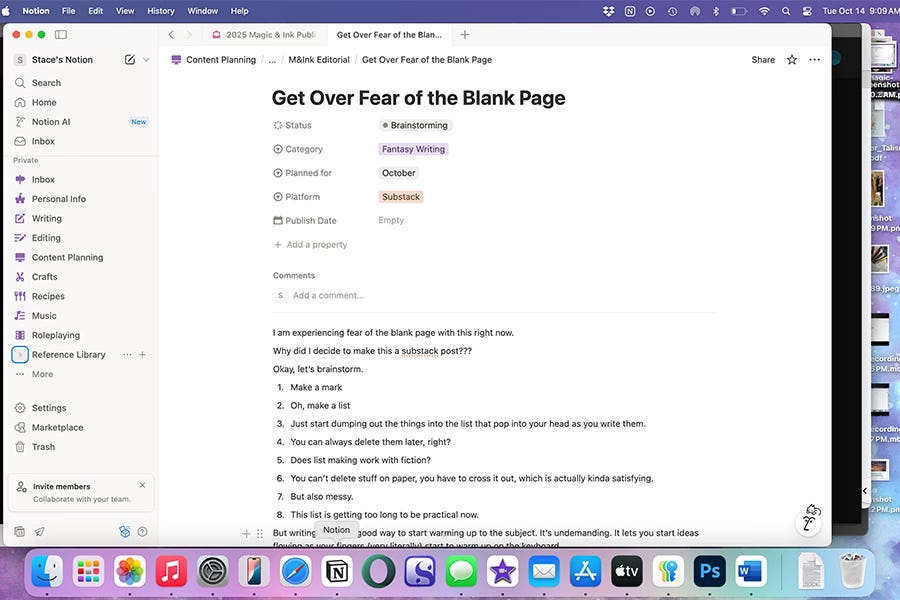
Another of my tricks is demonstrated in the screenshot above, which is what happened when I sat down to write the draft of this post in Notion. It’s a brain dump, really; in this instance, I had no idea what I was going to say on this topic, so I just started tossing ideas down as they came. The bullet points make it feel less formal, far away from any final version. If I am working on a piece with more structure, I might make it look more like an outline. (I know. Gah, what is this, middle school??)
Ultimately, it all comes down to just putting something on the page to break up that pristine perfection. Make a mark: that’s what I learned when I used to do a lot of art journaling. If you don’t know what you are going to make, just make something random, a swash of color or a squiggly line. It gives you something to work with, or work around, or work against — “No, not that!” It’s a place to start, and as we all know starting is the hardest part.
Of course, working digitally, I get to delete all my random marks, my stupid puns, my brainstorming bullet points. With a click of the mouse, the cursor sends them back into the void they came from — tap, tap, gone. They are not even ghosts in the final version of my piece.
But I don’t always work digitally. For me, sometimes the best way to discover what it is I want to write about is to do it the old fashioned way, with pen and ink in a notebook. Curiously, I almost never suffer from fear of the blank page when I write by hand, despite the fact that I can’t delete anything. I can cross things out, but whatever I put on the page is part of the permanent record.2
But the difference is that when I write by hand, my brain knows that it’s just a draft from the get-go. I don’t have to trick myself past the wall of perfection just to get started. My rambling exploration, experimental fits and starts, misspellings and other grammatical flaws can emerge without interruption or self-consciousness. The only person who is ever going to see it is me.
Unless someone snoops, in which case they get what they deserve.

I’d love to hear your thoughts about these tips. Do you struggle with fear of the blank page? Please leave a comment if you have, or if you have other suggestions for ways to break through this kind of block. Thanks for watching, please consider subscribing, and if you want to support my work, please buy me a chai!
You might also enjoy:


Not for this newsletter, but for my day job. If you want to pay me for this newsletter that would be keen, but no pressure.
I can’t help thinking at this point about how science was used to recover one of Tolkien’s earliest drafts of the tale of Beren and Luthien, which he wrote in pencil, then erased and wrote over with a newer version. I am offended on his behalf: how dare they! There was a reason he erased that version. He didn’t want other people to read it. It seems disrespectful to the author’s wishes to dredge through his trash in the name of scholarship.
Great post! It makes me thinks of how sometimes I have to force myself to be "inefficient" instead of "perfect", otherwise I'll end up not doing anything.
For example, I have to stop myself from doing unending research about what to write, because I feel like don't know enough about a specific topic - welp, now I'm able to catch and remind myself that I'll never feel like I know "enough" 😂 I just have to write and research as I go to get unstuck 😆